
The World of the Chimpanzee
Chimpanzees are not merely animals; they are a window into our own evolutionary past. As members of the great ape family, they inhabit the lush tropical forests and expansive grass savannas of equatorial Africa. Often referred to simply as chimps, these primates represent one of the most intelligent and socially complex species on Earth.
1. Evolutionary Origins and the Human Connection
Taxonomically, chimpanzees belong to the genus Pan, a classification they share with their cousins, the bonobos. Palaeontologists and geneticists discovered this link through rigorous fossil comparisons and genomic mapping. The results were staggering: chimpanzees are a sister taxon to the human lineage, sharing approximately 98.8% of our DNA.
This genetic proximity explains why chimpanzees exhibit behaviours we once thought were uniquely human, such as laughter, grief, and the use of complex tools. There are four confirmed subspecies of chimpanzees, each adapted to specific regions of the African continent:
- The Western Chimpanzee
- The Nigeria-Cameroon Chimpanzee
- The Central Chimpanzee
- The Eastern Chimpanzee
2. Physical Characteristics and Sexual Dimorphism
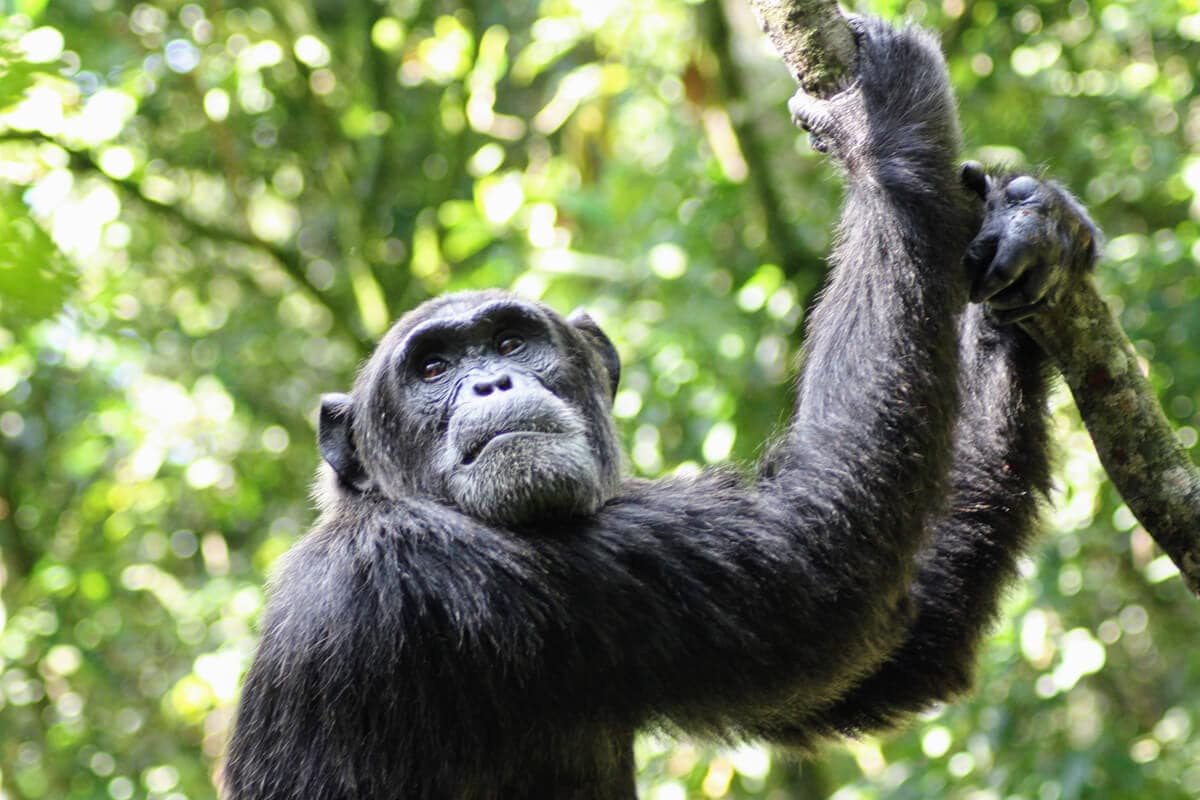
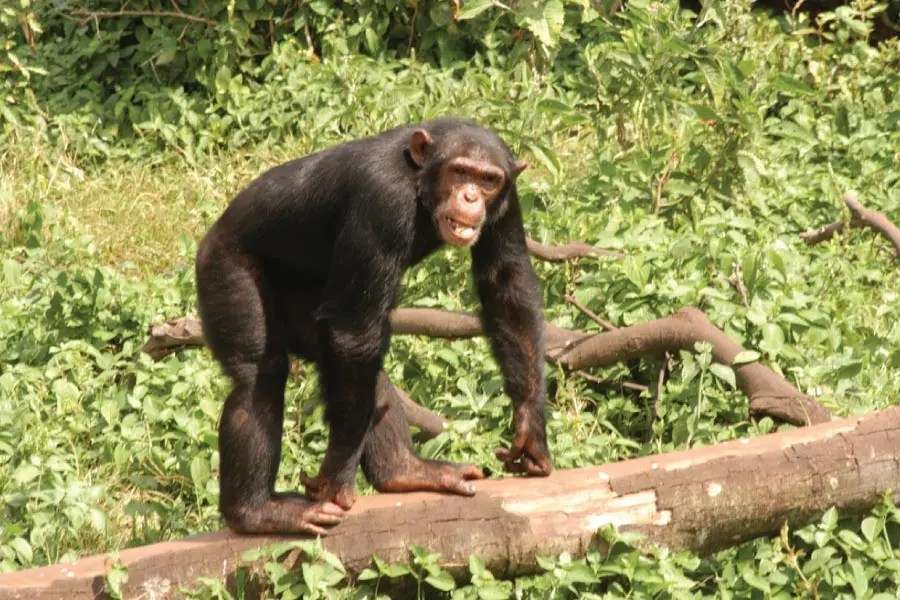
A chimpanzee’s physical appearance is both rugged and remarkably human-like. They possess bare faces often pinkish in youth and darkening with age 0and are covered in coarse black hair across most of their bodies. Unlike monkeys, they lack tails, a defining trait of all apes.
Their hands and feet are evolutionary masterpieces. With long fingers, opposable thumbs, and mobile big toes, they can grip branches with the same precision that a human uses to hold a pencil. Chimps are significantly more robust than bonobos. Adult males typically weigh between 40 and 70 kilograms, while females are smaller, ranging from 27 to 50 kilograms. Despite being shorter than the average human, a chimp’s muscle density makes it nearly four times stronger than an athletic person.
3. The Human-Like Intelligence of Chimps
Chimpanzees create lasting memories and shared experiences, which is why they fascinate tourists and researchers alike. Their day-to-day lives revolve around complex pillars: governance, feeding, and protection.
Their brainpower rivals that of a young human child. They excel at:
- Collaborative Problem Solving: Groups work together to corner agile prey or navigate difficult terrain.
- Complex Vocalisations: They use a language of hoots, screams, and grunts to signal everything from the discovery of food to the presence of a predator.
- Spatial Mapping: Chimps can remember the exact location of hundreds of fruit trees and predict when they will be in season.
4. Dietary Habits and the Forest Pharmacy
Chimpanzees are true omnivores. While they have a reputation for being fruit-lovers, their diet is incredibly varied. They consume:
- Vegetarian Staples: Fruits (the bulk of their diet), leaves, flowers, seeds, and nuts.
- Insects and Honey: They use sticks to fish for termites and bees.
- Meat: Chimps actively hunt small mammals, such as colobus monkeys and bush pigs.
Interestingly, chimps also practice self-medication. When they feel ill, they seek out specific bitter leaves or barks that contain anti-parasitic properties. They don’t eat these for nutrition; they eat them to fight diseases inside their bodies, effectively utilising a natural forest pharmacy.
5. Master Toolmakers of the Wild
One of the most significant discoveries in primatology was that chimps are naturally creative toolmakers. They don’t just find tools; they manufacture them.
- For Feeding: They use stones as hammers and anvils to crack open hard nuts.
- For Hunting: In some regions, chimps sharpen sticks with their teeth to create spears for stabbing prey hiding in tree hollows.
- For Hydration: They chew leaves into sponges to soak up water from deep crevices in logs.
- For Defence: When threatened, they use branches as clubs or throw rocks with surprising accuracy.
6. Complex Social Structures and Governance
Chimpanzees live in fission-fusion societies. A large community of 20 to 120 individuals rarely stays together in one spot. Instead, they break into smaller, interchangeable groups to forage during the day and gather back together at night or during times of plenty.
The social hierarchy is strictly male-dominated. An Alpha Male leads the group, but he doesn’t rule through strength alone. He must be a master politician, forming alliances with other males and maintaining the support of the high-ranking females. The Alpha settles disputes and protects the group from outsiders, ensuring the survival of the lineage.
7. Motherhood and the Cycle of Life
The reproductive cycle of a chimpanzee is slow, which makes their populations vulnerable. After an eight-month pregnancy, a mother gives birth to a single infant. For the first few months, the infant clings to the mother’s belly. Later, it transitions to jockey-style riding on her back.
Weaning occurs around age three, but the bond doesn’t end there. Young chimps remain dependent on their mothers for emotional support and education until they are nearly ten years old. Females often maintain a lifelong relationship with their mothers, while males eventually focus on rising through the ranks of the male hierarchy.

8. Threats to Survival: The Human Impact
Just like us, chimpanzees experience fear. Their greatest threats today are almost entirely human-driven:
- Habitat Loss: As forests are converted into farmlands, chimps lose their homes and food sources.
- Poaching: The illegal bushmeat trade remains a devastating industry.
- Human Diseases: Because we are so genetically similar, chimps can catch human illnesses. Common human viruses can be fatal to chimps, who lack our built-up immunity.
Severe conditions like cerebral infarction (stroke), pulmonary hypertension, and diabetes have been observed in ape populations. When an elder chimp dies, the group loses a library of knowledge. Since it takes 14 to 15 years for a chimp to reach breeding age, these losses are difficult to replace.
9. Conflict and Coexistence
While chimps generally fear humans and keep their distance, they are not passive animals. If cornered or if their family is threatened, they will fight back with incredible ferocity. This creates a tense dynamic in areas where human settlements encroach on wild territory.
To save the chimpanzee, we must protect the forests they call home. By supporting eco-tourism and anti-poaching initiatives, we ensure that these wonderful creatures continue to swing through the trees for generations to come.