
In 2026, while the world flocks to the “Impenetrable Forest” for its legendary mountain gorillas, a quieter, equally magnificent revolution is taking place in the canopy above. Bwindi has solidified its status as a “Global Birding Mecca,” hosting over 350 species, including 23 of the 24 Albertine Rift Endemics available in Uganda.
For the transformative traveler, birding in Bwindi is not just a hobby; it is a masterclass in biodiversity. Whether you are a seasoned ornithologist or a family looking to add a splash of color to your safari, these are the avian crown jewels of the forest.

This list represents the most sought-after species based on rarity, beauty, and their role as indicators of forest health.
Rank | Common Name | Best Sector | Rarity Level | Key Identification |
1 | African Green Broadbill | Ruhija (Mubwindi Swamp) | Extremely Rare | Small, bright green with a blue throat. |
2 | Shelley’s Crimsonwing | Ruhija / Rushaga | Vulnerable | Vivid red back and crown, black wings. |
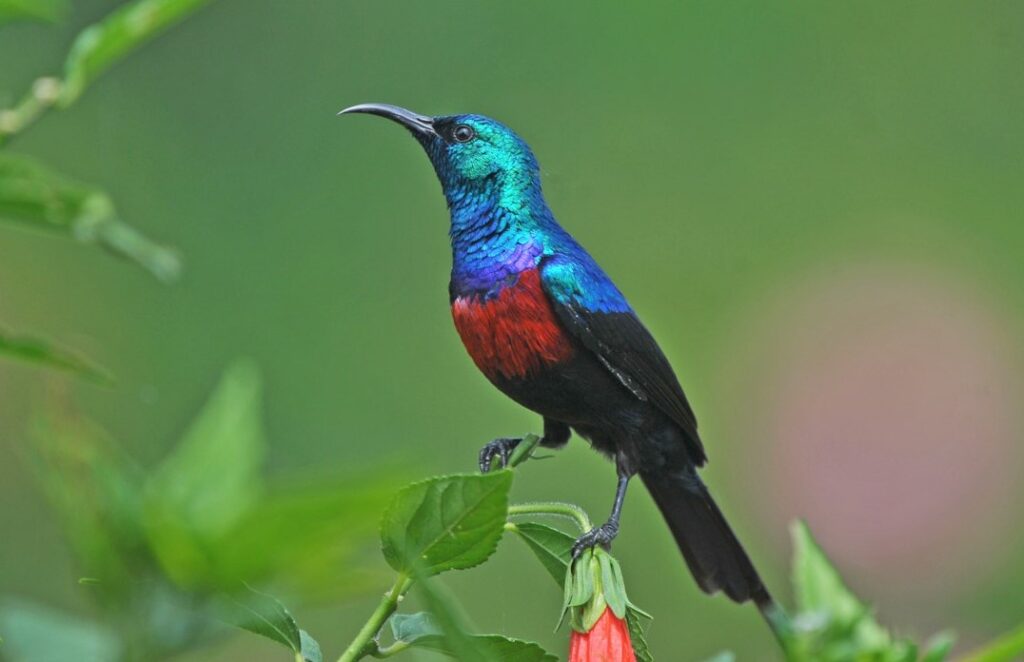
3 | Regal Sunbird | Buhoma / Ruhija | Albertine Endemic | Iridescent green head with a red/yellow breast. |
4 | Black Bee-eater | Buhoma | Localized | Velvet black with a bright red throat and blue belly. |
5 | Doherty’s Bush-shrike | Ruhija | Elusive Skulker | Bright red forehead with a broad black breast band. |
6 | Black-billed Turaco | Buhoma | Common Forest Bird | Green body with a white crest and red eye-ring. |
7 | Rwenzori Nightjar | Ruhija | Nocturnal | Dark, mottled plumage; best seen at dusk. |
8 | Kivu Ground Thrush | Buhoma / Ruhija | Ground Dweller | Orange fore-crown and distinct white wing bars. |
9 | Handsome Francolin | Ruhija / Mgahinga | Albertine Endemic | Red legs and bare red facial skin. |
10 | Grauer’s Rush Warbler | Ruhija (Swamp) | Endangered | Heavily streaked breast; found in high-altitude bogs. |
As we detailed in our Difficulty Levels Guide, Bwindi’s terrain varies by sector. This holds for birding as well; your choice of sector will dictate which species you cross off your list.
Ruhija is the undisputed king of Bwindi birding. Because of its elevation ($2,300m+$), it is the only place to find the African Green Broadbill.
If you prefer a gentler pace, the Buhoma Waterfall Trail offers incredible birding with less vertical strain.
Timing your visit to Bwindi for birds is different than timing it for gorillas. While gorillas are visible year-round, bird activity peaks during specific biological cycles.
In 2026, birding is being used as a tool for Transformative Wildlife Travel.
The “Impenetrable” forest presents unique technical challenges:
A common mistake is trying to “squeeze” birding into a gorilla trek. In 2026, we recommend a Dedicated Birding Day.
Bwindi is more than a home for apes; it is a cathedral of sound and color. Whether you are hunting for the “Green Broadbill” or just enjoying the melody of a “Regal Sunbird,” birding adds a layer of depth to your safari that stays with you long after the silverback has disappeared into the mist.
Would you like us to book one of our “Expert Birding Guides” for your 2026 Ruhija expedition?