
When travelers dream of the “Primate Capital of the World,” Uganda’s Kibale National Park, the conversation usually centers on the dry months of June or December. However, for those seeking the pinnacle of primate encounters, the Chimpanzee Habituation Experience (CHEX), there is a secret window that seasoned researchers and luxury safari specialists guard closely.
Why March is the Secret “Golden Month” for Chimpanzee Habituation in Kibale? It is a time of transition, where the forest awakens in a riot of color, the chimpanzees descend from the high canopy to the forest floor, and the crowds of the peak season are nowhere to be found.
In this comprehensive guide, we explore why a March expedition to Kibale is the most strategically sound choice for the high-end traveler in 2026.

To appreciate the magic of March, one must first understand what makes Habituation distinct from a standard trek.
A standard chimpanzee trek is a one-hour encounter with a “fully habituated” troop, chimps that are so accustomed to humans they essentially ignore them. While spectacular, it is a curated, time-limited experience.
The Chimpanzee Habituation Experience (CHEX) is a full-day or half-day (minimum 4 hours) immersion. You are not just a visitor; you are a silent observer accompanying Uganda Wildlife Authority (UWA) researchers as they work to acclimate “semi-habituated” communities to human presence. In March, this process becomes significantly more interactive due to the environmental factors unique to the start of the “long rains.”
The single most important driver of chimpanzee behavior is food. In the peak dry seasons (January and February), the forest can become parched. Fruit becomes scarce, and chimpanzee communities, which can number over 100 individuals, break into small “fission” groups to forage deep in the inaccessible thickets.
March changes everything. As the first rains of the year arrive, the forest undergoes a massive “fruiting event.” The wild figs (Ficus species) and the fruit of the Uvariopsis congensis tree begin to ripen in abundance.
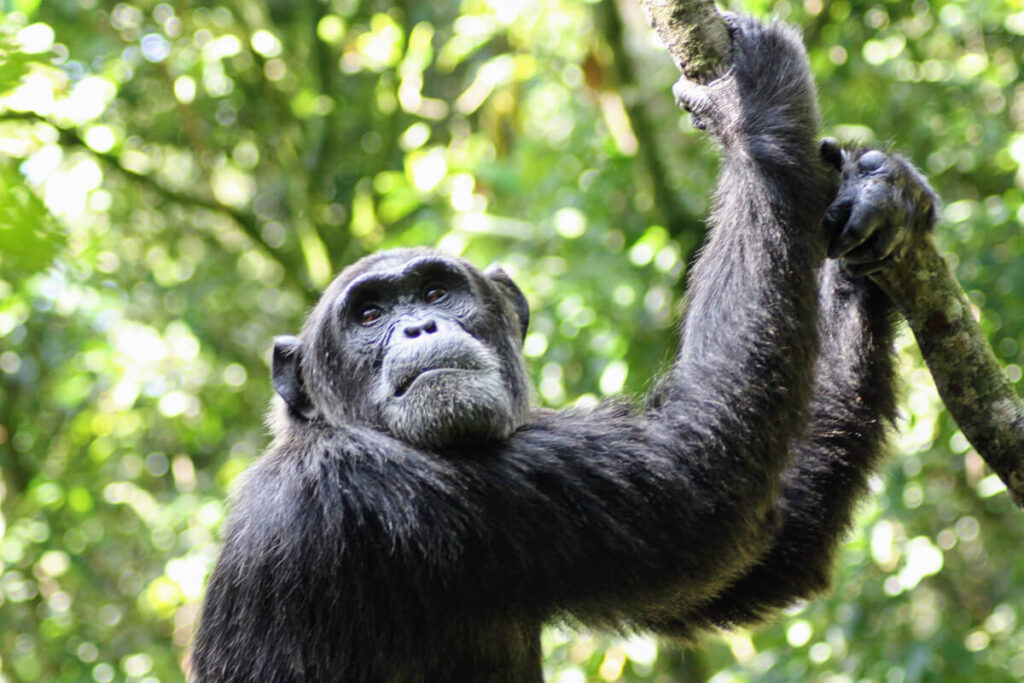
When food is scarce, chimps spend their time high in the 50-meter canopy, making photography difficult and causing “binocular neck” for travelers. In March, the sheer weight and volume of fruit on lower branches and the forest floor draw the communities down. You aren’t just looking up at silhouettes against a bright sky; you are sitting on a mossy log at eye level with a silverback or a mother nursing her infant.
Many travelers are scared away by the term “Rainy Season,” which begins in late March. This is a mistake that luxury travelers can use to their advantage.
The Weather Pattern
In Kibale, the rains in March are rarely the “washout” events people fear. Instead, they typically manifest as spectacular, short-lived afternoon thunderstorms. The mornings, when habituation begins at 6:30 AM, are often cool, misty, and ethereal.
The Photographer’s Dream
For a high-end photographer, the dry season is the enemy. It brings dust, haze, and “flat” light. March brings dynamic light. The rain washes the dust from the air, resulting in a “color pop” where the emerald greens of the ferns and the deep blacks of the chimpanzee fur become incredibly vivid. The mist clinging to the ancient trees provides a cinematic atmosphere that no dry-season sun can replicate.
Because food is abundant in March, the chimpanzees have a “surplus” of energy. In the lean months, chimps are lethargic, focused entirely on survival and calorie conservation.
In the “Golden Month” of March, the social atmosphere of the forest is electric:
In 2026, the luxury of “space” is the most expensive commodity. During the peak months, the Kanyanchu Visitor Center can feel like a busy trailhead.
In March, the “shoulder season” effect takes hold.
March in Kibale is not just about the chimpanzees. The park is home to 12 other primate species, and the “Golden Month” affects them all.
The Birding Bonanza
Kibale is a premier birding destination with 375 species. In March, many forest birds are in their breeding plumage. It is also the best time to see the elusive Green-breasted Pitta, one of Africa’s most sought-after birds, which is displayed specifically during the onset of the rains.
The Butterfly Migration
Visitors in March are often treated to the sight of thousands of forest butterflies congregating around puddles in the forest paths, a phenomenon known as “puddling”, which creates a kaleidoscope of color as you trek.
To execute a perfect March safari, the logistics must be handled with precision.
Fly-In Access
Avoid the 6-hour drive from Entebbe. In 2026, we recommend a private charter flight to the Kasese Airstrip. From there, a 1-hour luxury transfer brings you to the heart of the Kibale region. This ensures you arrive fresh for the early 6:00 AM start required for habituation.
The Gear Strategy
March requires specific equipment to ensure comfort:
8. Sustainability and Impact
By choosing a March habituation, you are providing critical support to the Uganda Wildlife Authority during a time when tourism revenue typically dips. Your permit fee ($250 per person) goes directly toward:
If you are traveling to Uganda in 2026, you are already seeking one of the world’s most exclusive wildlife experiences. Why limit that experience to a single hour?
March offers the rare opportunity to “disappear” into the forest. To watch the sun rise through the mist, to hear the first territorial call of the morning, and to spend an entire day walking in the footsteps of our ancestors. It is a month of abundance, of vivid color, and profound intimacy.
Kibale is waiting. The figs are ripening. The chimps are descending. March is your window.
Day | Activity | Luxury Accommodation |
Day 1 | Fly-in to Kasese; Afternoon crater lake walk or community coffee tour. | Kyaninga Lodge |
Day 2 | Full-Day CHEX: Dawn-to-dusk chimpanzee habituation experience. | Primate Lodge (Luxury Cottage) |
Day 3 | Bigodi Wetland Sanctuary walk (top-tier birding); Private transfer to Queen Elizabeth NP or fly-out. | Departure |
Would you like Primate World Safaris to check the 2026 permit availability for your preferred dates in March?