
Every August, the image of the Great Migration is the same: hundreds of wildebeest plunging into the Mara River while a parking lot of 80 safari vehicles watches from the banks. In 2026, the sophisticated traveler is looking for something else, the raw, unscripted drama of the crossing without the hum of twenty idling engines.
At Primate World Safaris, we’ve mapped out the Secret Geometry of the 2026 migration. By understanding the lesser-known tributaries and the private loops of the Mara and Serengeti, you can witness the world’s greatest wildlife show in total intimacy.
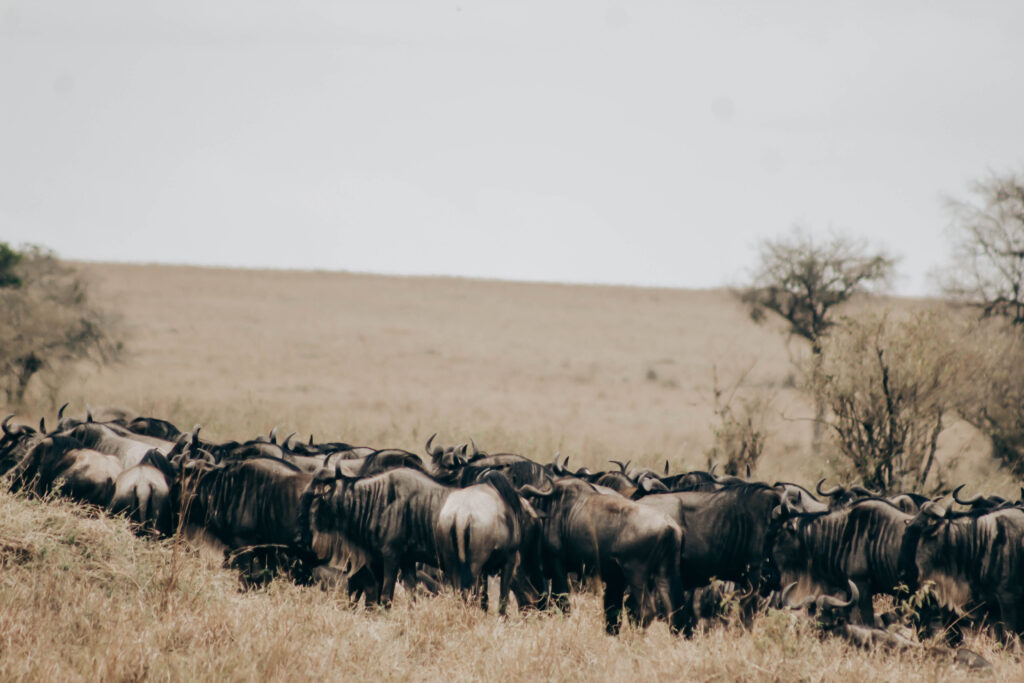
While the Main Crossing near Serena Lodge draws the masses, these five locations offer high-stakes drama with significantly lower vehicle density.
Secret Spot | Location | Why it’s Hidden | Best Month (2026) |
The Sand River Gate | Kenya/Tanzania Border | Shallow waters and a no-man’s-land feel, far from the main lodges. | Late July – August |
The Lamai Wedge | Northern Serengeti | Isolated by the Mara River and accessible only via a single seasonal bridge. | August – September |
The Grumeti River | Western Serengeti | Often ignored in favor of the Mara, home to the world’s largest crocodiles. | June – July |
The Paradise Crossing | Mara Triangle | Known for steep, treacherous banks that deter the average day-tripper. | August – October |
Talek River Loops | Central Maasai Mara | A smaller tributary where herds cross in intimate, manageable groups. | September |
The Sand River is the migration’s Front Door. This is where the herds first enter the Maasai Mara from the Serengeti.
The Lamai Wedge is a triangular spit of land between the Mara River and the Kenyan border. It is effectively cut off from the rest of the Serengeti.
If you want to see the 2026 migration but are traveling in June or July, skip the Mara and head to the Grumeti in the Western Serengeti.
The Mara Triangle is the western side of the Maasai Mara, managed by a private conservancy. It has stricter rules on vehicle numbers than the main reserve.
The Talek is a tributary of the Mara River. While it lacks the scale of the main river, it offers the best up-close views.
To truly escape the crowds, your 2026 strategy must involve Private Conservancies.
Conservancy | Best For | Exclusive Perk |
Mara North | High-end seclusion | Only 5 vehicles allowed per sighting. |
Enonkishu | Off-the-beaten-path | Amazing for night safaris after the herds cross. |
Olare Motorogi | Big Cat density | Watch lions wait for the crossing herds in total privacy. |
No. Anyone who says otherwise is misinformed. River crossings are driven by herd psychology and thirst. A herd may stand on the bank for 4 hours and then simply turn around.
Expert Tip: Book at least 4 nights in a single river-adjacent camp to increase your probability to 90%.
In the National Reserve, there is no limit to the number of cars at a crossing. In a Private Conservancy (like Mara North or Naboisho), numbers are strictly capped. You pay a bit more, but you buy the silence.
The Sand River is shallow, and the entry point is usually in July. The Mara River is deep, dramatic, and the primary obstacle in August and September.
No. The Great Migration is strictly a Kenya/Tanzania event. However, in 2026, many travelers link the Mara Crossings with Uganda Gorilla Trekking because they are only a 2-hour flight apart.
Contrary to popular belief, they don’t just happen at dawn. Most crossings occur between 10:00 AM and 3:00 PM when the sun is high, and the wildebeest are thirstiest.

In 2026, the greatest luxury in Africa isn’t a gold-plated bathtub; it’s the sound of the wind across the savannah without the interruption of a dozen radio-dispatched vans. By choosing the Lamai Wedge or the Sand River, you aren’t just seeing the migration; you are experiencing it the way the early explorers did.
Our guides at Primate World Safaris use a real-time tracking network to move our guests away from the crowds.