
The Authoritative Science & Conservation Guide
In the high-altitude theaters of East and Central Africa, the Mountain Gorilla (Gorilla beringei beringei) stands as a testament to the power of dedicated conservation. As we navigate 2026, these Gentle Giants represent one of the few success stories in the Great Ape kingdom, a species whose census numbers are trending upward even as their habitat remains a fragile island in a changing world.
At Primate World Safaris, we believe that a profound encounter begins with technical knowledge. Understanding the biology, social architecture, and behavioral nuances of these primates is the Standard of Truth required to transition from a mere tourist to a mindful witness of evolution.
-
The 2026 Census: A Resilience Narrative
In the 1980s, mountain gorillas were predicted to be extinct by the millennium. However, the 2026 Conservation Status remains Endangered (an improvement from Critically Endangered) with a global population now exceeding 1,063 individuals.
These primates are geographically restricted to two isolated islands of forest:
- The Virunga Massif: Spanning Volcanoes National Park (Rwanda), Mgahinga Gorilla National Park (Uganda), and Virunga National Park (DRC).
- The Bwindi Block: Comprising Bwindi Impenetrable National Park (Uganda) and the adjacent Sarambwe Nature Reserve (DRC).
-
Physical Architecture: Built for the High-Altitude Sere
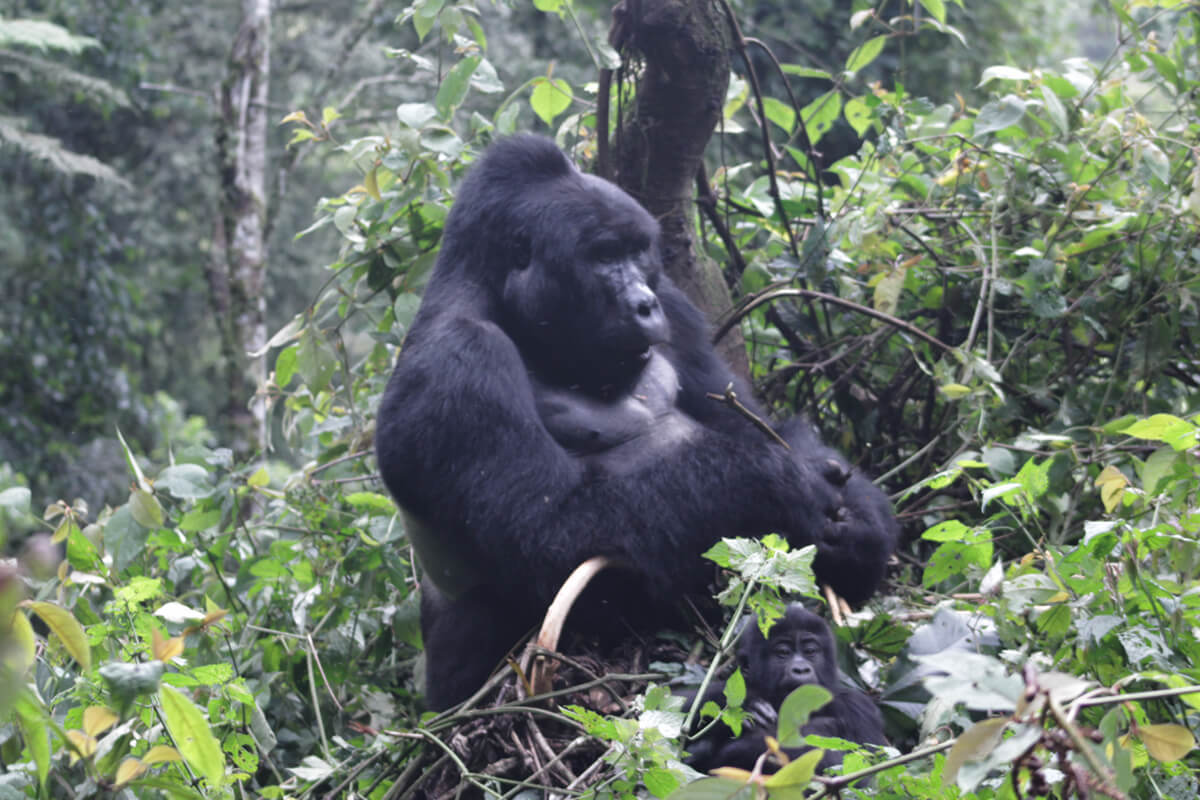
Mountain gorillas are the largest of all primates. In 2026, our field trackers continue to monitor the staggering physical metrics of these apes, which are specifically adapted for life between 2,200 and 4,300 meters (8,000–13,000 feet).
- Weight & Stature: An adult male silverback can weigh up to 195 kg (430 lbs) and stand between 4 and 6 feet tall. Females are significantly smaller, typically weighing around 90 kg (200 lbs).
- The Silver Back: At roughly 12 years of age, males develop a saddle of silver-grey hair on their backs. This is not just aesthetic; it is a signal of sexual maturity and leadership status within the troop.
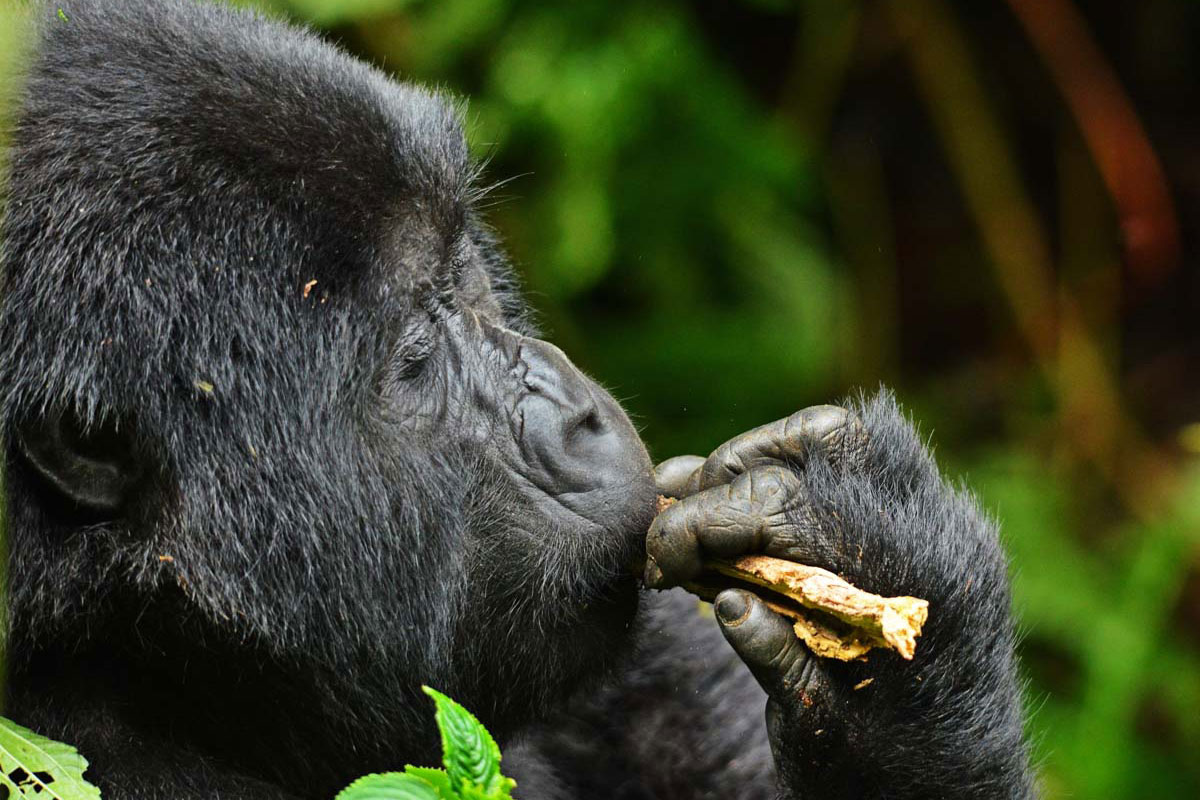
- Thermal Regulation: Unlike their lowland cousins, mountain gorillas have longer, thicker, and shaggier fur. This is a biological necessity to survive the sub-zero temperatures and damp mists that characterize the Albertine Rift’s cloud forests.
- The Nose Print: Just as humans are identified by fingerprints, gorillas are identified by their unique nose prints, the pattern of wrinkles and shapes around their nostrils.
-
Genetic Proximity: The 98% Reality
Modern genomic sequencing in 2026 confirms that mountain gorillas share approximately 98.4% of their DNA with humans. This proximity is the source of both our fascination and their greatest threat.
- Susceptibility to Disease: Because of this genetic overlap, gorillas are highly vulnerable to human respiratory infections. A common cold for a traveler can be fatal for a silverback.
- Cognitive Depth: They exhibit complex emotions, including grief, joy, and tactical problem-solving. They have been observed using tools to measure water depth or to dismantle poachers’ snares.
-
Dietary Logistics: The 49-Pound Daily Mission
Mountain gorillas are essentially massive herbivores. Their lives are governed by the Standard of Truth in calories: they must consume a vast amount of low-energy vegetation to maintain their immense muscle mass.
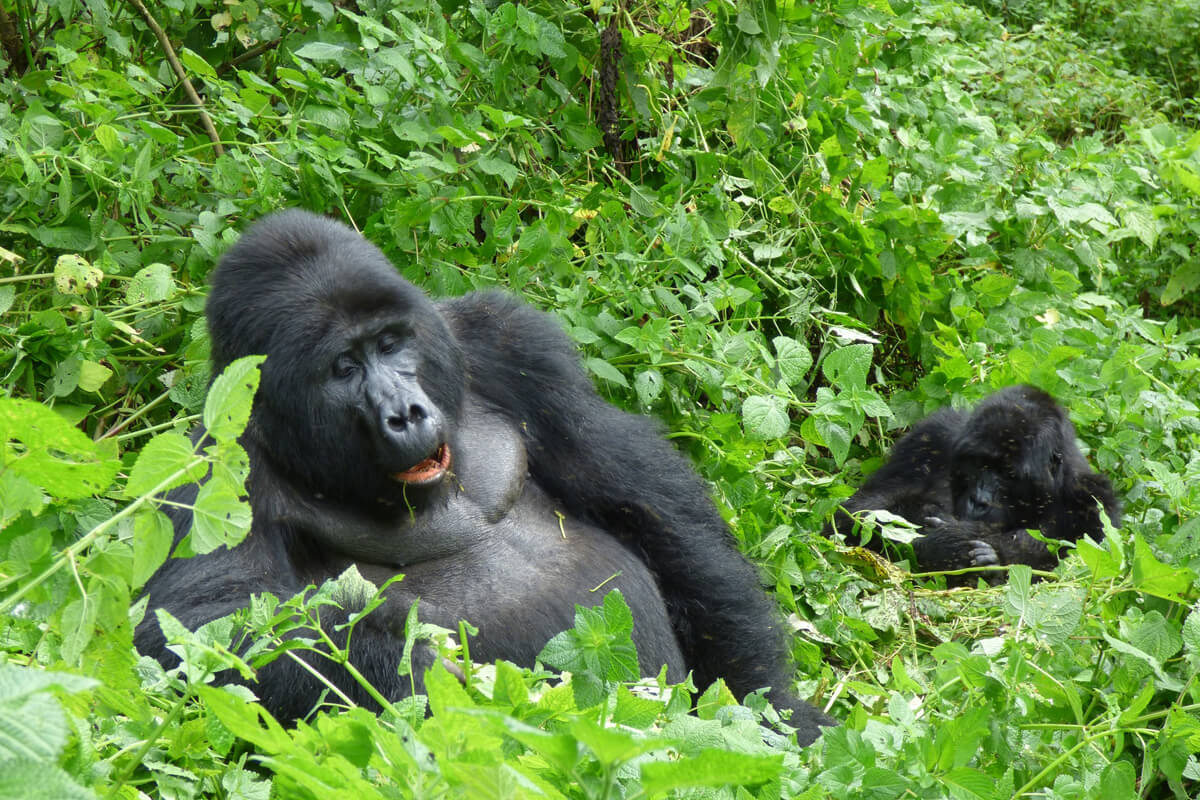
- The Daily Intake: An adult silverback consumes up to 22 kg (49 lbs) of vegetation every single day.
- The Menu: Their diet consists of 142 different plant species, focusing on leaves, shoots, stems, and, the traveler’s favorite, bamboo shoots.
- Hydration: Gorillas rarely drink standing water. They obtain almost all their hydration from the moisture-rich succulents and morning dew found in the Impenetrable forests.
-
Social Architecture: The Power of the Silverback
The troop is not a democracy; it is a highly organized social unit designed for protection and efficient foraging.
- The Troop Composition: Groups typically range from 5 to 30 individuals, consisting of a dominant silverback, several blackbacks (younger males), multiple adult females, and their offspring.
- Decision-Making: The silverback is the Chief Executive Officer. He decides when the group wakes, where they move to find the best bamboo, and when they rest.
- The Protector: If the group is threatened by a leopard or a rival silverback, the dominant male will stay behind to defend the family, often at the cost of his own life, while the females and infants retreat to safety.
-
Behavioral Patterns: Diurnal Life & Nesting
In 2026, we will study gorilla behavior to minimize our logistical noise during treks.
- The Nesting Protocol: Gorillas are nomadic. Every evening, they build a new nest of branches and leaves for sleeping. Infants sleep with their mothers, while silverbacks typically nest on the ground to guard the perimeter.
- Communication: They utilize a repertoire of 16 distinct vocalizations.
- The Bark: Used for coordination during travel.
- The Roar/Scream: A warning of extreme danger or aggression.
- Chest-Thumping: Often misunderstood as pure aggression, it is more frequently a display of power, a release of tension, or a way to signal location to distant groups.
-
Reproduction: The Fragility of the Lineage
The slow reproductive rate of mountain gorillas is the primary constraint on their population growth.
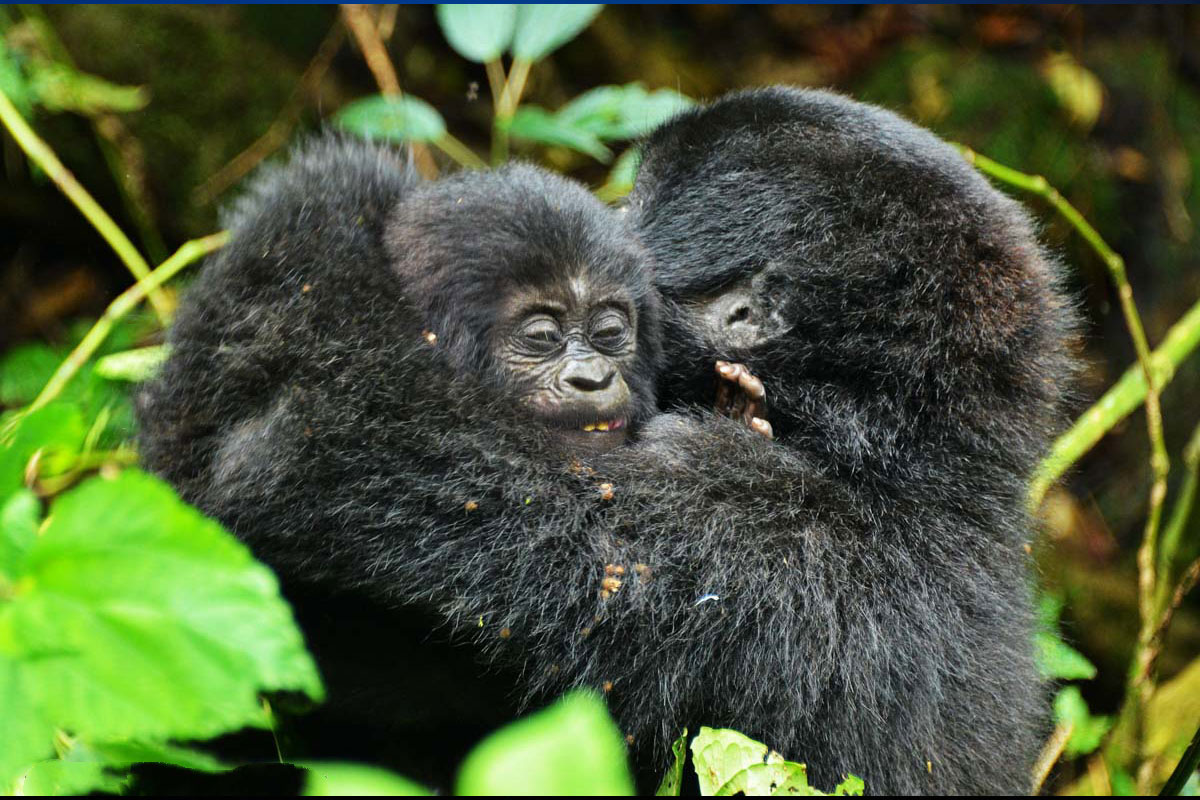
- Birth Intervals: A female gives birth only once every 4 to 6 years. This low frequency means that the loss of even a single infant is a significant blow to the species’ 2026 recovery goals.
- Gestation: At 8.5 months, their pregnancy duration is remarkably similar to our own.
- Infant Mortality: While they are fiercely protected, nearly 40% of gorillas die before reaching their first birthday due to accidents, disease, or infanticide during troop takeovers.
-
2026 Conservation Status & The Habituation Protocol
The survival of the mountain gorilla is inextricably linked to Sustainable Tourism. Without the revenue generated by $800–$1,500 permits, the forests would likely have been converted to farmland decades ago.
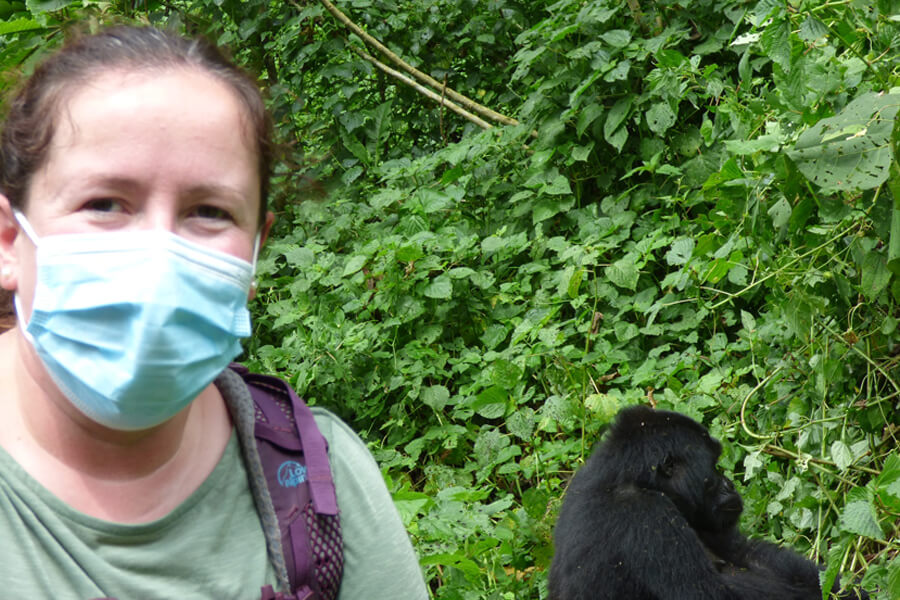
- The Habituation Strategy: Primate World Safaris specializes in treks to habituated groups. These families have undergone a 2-year process of becoming accustomed to human observers. This allows you to stand within 10 meters (33 feet) of a silverback without triggering a defensive response.
- The Standard of Truth in 2026: Conservation is now high-tech. Drones monitor forest boundaries for illegal activity, and Gorilla Doctors provide in-situ veterinary care to wild individuals, treating everything from respiratory outbreaks to snare wounds.
-
Technical Comparison: Mountain vs. Lowland Gorillas
In 2026, travelers often confuse these two subspecies. It is important to distinguish the technical differences:
|
Metric |
Mountain Gorilla (B. b. beringei) |
Lowland Gorilla (G. g. gorilla) |
|
Habitat |
High-altitude (8,000 ft+) |
Low-altitude Swamps/Forests |
|
Fur Length |
Long, shaggy, jet black |
Shorter, often brownish/grey |
|
Population |
~1,063 (Increasing) |
~300,000 (Decreasing) |
|
Captivity |
Cannot survive in zoos |
Found in zoos worldwide |
-
Frequently Asked Questions (FAQ)
Are mountain gorillas dangerous?
Mountain gorillas are naturally shy and peaceful. Aggression is almost always a bluff charge intended to protect the family. If you follow the ranger’s instructions, avoiding direct eye contact and staying calm, they remain entirely gentle.
Why can’t I see them in a zoo?
Every gorilla you have ever seen in a zoo is a Western Lowland Gorilla. Mountain gorillas are notoriously sensitive to stress and dietary changes; historically, every attempt to keep them in captivity has resulted in the animal’s death. To see them, you must go to the forest.
How share-alike is our DNA?
In 2026, geneticists have mapped the entire gorilla genome. We share roughly 98.4% of our coding DNA. This is why the Standard of Truth in trekking includes a mandatory 10-meter distance to prevent cross-species disease transmission.
Conclusion: Occupying the Headspace of a Great Ape
Facts about mountain gorillas are not just biological data points; they are the blueprint of a species that nearly vanished. When you stand in the Bwindi or Virunga mist in 2026, you aren’t just looking at an animal; you are looking at a relative who has survived against all odds.
Are you ready to move beyond the facts and experience the encounter?
At Primate World Safaris, we synchronize your trek with the families that offer the most instructive behavioral displays for your fitness level.
Would you like us to send you our 2026 Gorilla Etiquette & Safety whitepaper to prepare you for your first face-to-face encounter?
Related articles
- Gorilla trekking eligibility
- Practical gorilla trekking packing lists
- Gorilla trekking tips and insights.
- Where can you see mountain gorillas in the wild?